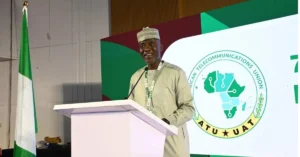


EVC of NCC, Dr. Aminu Maida and Minister of Communications, Innovation and Digital Economy, Dr. Tijani Bosun at an event
To drastically reduce damages to road facilities, the Nigerian Communications Commission (NCC) has restated total commitment to promoting efficient broadband infrastructure deployment through the collaborative implementation of the Dig Once Policy (DOP) aimed at reducing deployment costs and expanding telecommunications infrastructure across Nigeria.
In a statement signed by the Director of Public Affairs, NCC, Nnenna Ukoha, and made available to Business Hilights.ng, the telecoms regulator gave the assurance during the Second Stakeholders’ Consultative Forum on Developing a Pricing Mechanism and Cost-Based Structure for Sharing Ducts Built Under the Dig Once Policy, held at the NCC Annex Office in Mbora, Abuja.
The forum brought together representatives of federal and state government institutions, telecommunications operators, infrastructure companies, industry associations, development partners and other key stakeholders to review interim findings of an ongoing study and contribute to the development of a transparent, equitable and cost-based framework for sharing underground duct infrastructure.
Speaking at the event, NCC’s Director of Policy, Competition and Economic Analysis, Mr Ayuba Shuaibu, said the engagement demonstrated the Commission’s commitment to an open, transparent and inclusive regulatory process that accommodates the interests of infrastructure providers, network operators, public institutions and consumers.
He added that “The Commission remains committed to a transparent, inclusive and consultative process. Our objective is to arrive at a pricing structure that balances the interests of infrastructure providers, access seekers and, ultimately, consumers, while also encouraging continued investment in broadband infrastructure,”

Shuaibu explained that the proposed framework is designed to encourage infrastructure sharing, improve asset utilisation, reduce the cost of broadband deployment and facilitate the expansion of telecommunications infrastructure nationwide.




According to him, the study seeks to establish a fair and transparent pricing mechanism for sharing underground ducts deployed under Nigeria’s Dig Once Policy, which promotes the installation of telecommunications ducts during road construction and rehabilitation projects to enable future fibre deployments without repeated road excavations.
Delivering the keynote presentation, Managing Director of Dimension Data Limited, Mr Olugbenga Olabiyi, described passive infrastructure such as ducts, conduits and manholes as some of the most capital-intensive components of broadband network deployment globally.
Olabiyi said infrastructure sharing had become an effective strategy for reducing deployment costs, improving operational efficiency and accelerating broadband expansion. He noted that Nigeria’s adoption of the Dig Once Policy provides an important opportunity to strengthen coordinated infrastructure deployment, minimise avoidable road excavations and improve the utilisation of existing infrastructure.
“For Nigeria, where broadband expansion remains a national priority under the National Broadband Plan, successful implementation of the Dig Once Policy could become one of the most impactful infrastructure reforms in our telecommunications history.”