
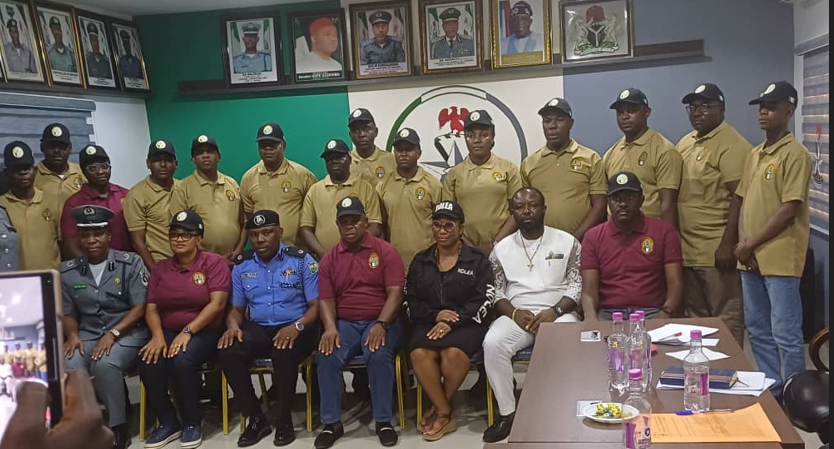
Partiipants and the Chairman of Association of Nigerian Licensed Customs Agents (ANLCA), Onne Seaport Chapter, Hon. Ifeanyi Isikaku in his presentation at the College Curriculum for Junior Course (JC) of the Nigerian Customs Service (NCS) Command and Staff College, Gwagwalada (NCCSC), on the occasion of Operational Study Tour for Students of JC 21 of NCCSC to Federal Operations Unit (FOU), Zone C, Owerri recently
No doubt, “The Nigeria Customs Service is duty-bound by the law establishing it, to serve primarily on economic and security purposes. To this extent, the long-term goal of national security is achieved through the strategic critical role of the Customs, through modernization of control procedure”.
This was the submission of the Chairman of Association of Nigerian Licensed Customs Agents (ANLCA), Onne Seaport Chapter, Hon. Ifeanyi Isikaku in his presentation at the College Curriculum for Junior Course (JC) of the Nigerian Customs Service (NCS) Command and Staff College, Gwagwalada (NCCSC), on the occasion of Operational Study Tour for Students of JC 21 of NCCSC to Federal Operations Unit (FOU), Zone C, Owerri recently.
According to him, “Due to the nature of the Service, the control mechanisms get more complex as it progresses, because of its multi levels of access, command and control. Yet, technology simplifies it through proactive control procedure.
Hon. Isikaku averred that “In this digital age, technology has continued to evolve at a very fast pace. Therefore, to be at par, the Nigeria Customs Service needs to deploy a geometric progression speed as against the arithmetic progression of technology to avoid playing catch-up. To this end, real time online platforms should be provided by the second interplay, among all the protocols in the international trade environment.
While noting that “Modernization enables Customs to determine the truth in some transactions that are not very transparent. Modernization and deployment of technology plug revenue loopholes and ensures no revenue loss to the government”, he was of the view that “Modernization through technology also helps to guarantee balance of trade. This also ensures that the country is not turned into a dumping ground for all sorts of items.”
However, he argued that “To achieve the set out objectives, the Nigeria Customs Service would have to work in various ways and terms of partnership with other bodies or entities. One of such is through collaborations with sister agencies locally.
“Just like in the financial sector, where there are lots of inter-agency collaborations with Police Fraud Unit, EFCC, NDLEA, ICPC etc. Any suspicion of fraudulent activity on a particular account number, such account is flagged and placed on lien, until a resolution is reached. Such a platform can accommodate the Nigeria Customs Service to flag any container, suspected to carry illegal items or is suspected to be aiding and abetting money laundering or any other fraudulent economic activity.
“The Nigeria Customs’ B’Odogwu can as well accommodate inter-agency platforms, so that when an entity is flagged, such flagging should be viewed in real time across inter-agency platform to enhance collaboration and action.


However, the Nigeria Customs Service has continued to define its operations by modernizing its operational parameters. In view of the above, the collaborative initiatives with other countries’ Customs Services on working tours and assessment on modern approaches to service delivery becomes a continuous process.
“Periodically, exchange of programme will serve useful purpose by exposing officers and men to the dynamics of the job in various and different locations around the world. Experiences garnered will become an integral part of the policy development process.
This collaborative effort should be extended to, not just other Customs Services, but to other international organizations like: Interpol, African Union agencies, UN agencies, EU agencies, DEA etc.
“The benefits of such extensive and intentional collaborations will often be seen in checkmating the proliferation of small arms and other dangerous merchandise, which ultimately fuels conflicts and engenders terrorism across the regions. Secured borders are testament to effective border management and territorial integrity, through collaborative effort of Nigeria Customs Service, Immigration Service, Quarantine Service, DSS, the military, police etc.
Modernization of the control procedure also requires kinetic and non-kinetic approaches.
In summary, Hon. Isikaku averred that “Agencies should see themselves as partners and not competitors. This is often influenced by glory-hunting. Policy makers should constantly evolve to be in tune with present realities.
According to him, “Management should not alienate themselves from the rank and file and to be in touch with current developments. While periodic evaluation of control procedure for operational efficiency is equally, recommended.”