
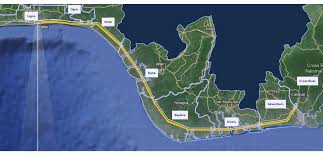
How the Lagos-Calabar Highway will traverse the coastal states. But what businesses have been existing along the coast before now to drive the value of the road, NONE.
Since the massive hype and resumption of construction activities, there have been several paid analysis drumming the importance of the highway with very infinitesimal conviction especially all those empty hypes put up by some short-sighted social media to manipulate the intelligence of minors in transportation studies.
The 700-kilometre Lagos Calabar Coastal Highway, which had started with federal executive fiat exactly at the foot of Eko Atlantic City, Victoria Island, will be traversing Ogun, Ondo, Edo, Delta, Bayelsa, Rivers, and Akwa Ibom State before terminating at Cross River State.
From all indications, the first clear fact to the highway is that loneliness will frustrate the road on completion because there has not been any convincing research that showed that residents of the entire coastal states from Lagos to Calabar have any form of business activities in common that will be the attracting force to use the road after all.
Yes, when completed, it will be the longest coastal highway in Africa and besides, according to some analysts, “Imagine driving for endless miles and just seeing the turquoise-blue colours of the Atlantic Ocean. It will almost feel as if you are driving to heaven,” the question is what will be the force of attraction to use the highway?
Is it inter-state coastal businesses that do not exit and will never exist?
What is Lagos residents needing from the rest of the states on the stretch along the coast lines?

 The Reno Omokri’s naïve narrative that with the Lagos-Calabar Coastal Highway, you will no longer have to depend on ports in Lagos or Port Harcourt because the freeway will link seven ports, including Tin-Can Island, Lekki, Koko, Warri, Port Harcourt, Gelegele and Calabar ports does not hold any water if you really know the national politics frustrating all other ports outside Lagos State. Reno may not know that all other Nigerian ports are officially kept in limbo so that Lagos ports will continue to flourish.


So the logic that “For the layman who does not understand what this means, it translates to cheaper importation costs, because ships would no longer accrue demurrage charges while waiting to berth at the congested Lagos ports,” is just a figment of many people’s imagination.
There are no other ports to choose outside Lagos because they are not made functional like those of Lagos.
Besides, the cheap logic that “The multiplier effect of this is that Nigerian corporations and individuals will eventually stop using the Port of Cotonou in Benin Republic, meaning that the increased marrying traffic will almost immediately increase our GDP,” does not hold water because the obnoxious and very discouraging goods clearing procedures at Lagos ports are still inherent till tomorrow.
Like several seasoned transport analysts have posited, the project will end up being very useless and poorly utilized as there has not been any need for a coastal road in the first place. What would have sparked off need for a coastal road would have been the existence of massive coastal water transportation amongst the traversing seven states. But that does not exist.
In fact, like one analyst has said. The target of the project is to selfishly grow the land value of Eko Atlantic City where it all started in Lagos State after all.