
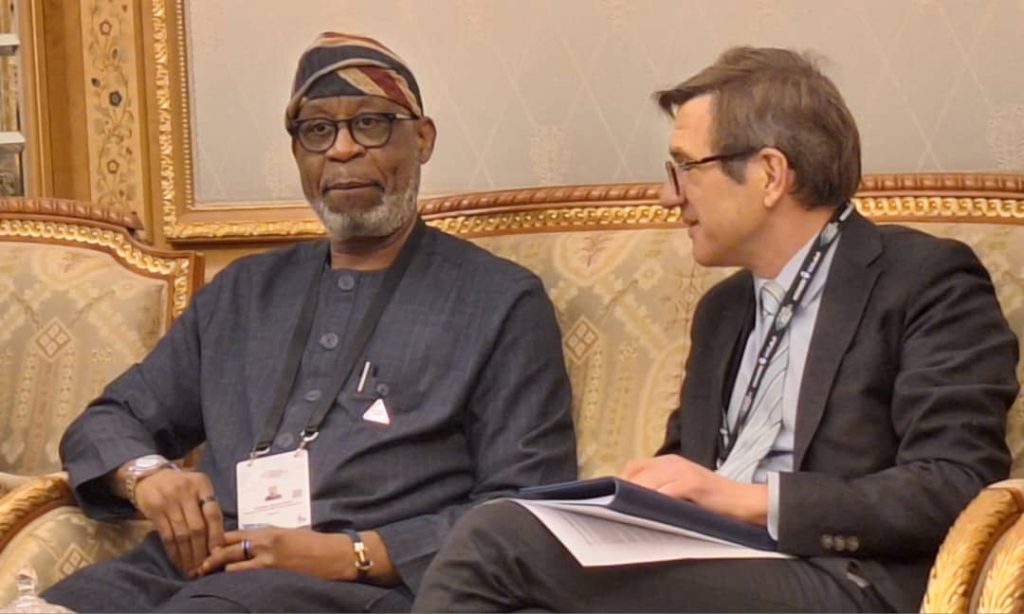
Minister of Solid Minerals Development, Dr. Dele Alake and France’s Inter-ministerial Delegate for Strategic Minerals, Benjamin Gallezot during the signing of the MoU recently
Africa’s energy story in 2025 reflects a region of growing strategic importance, with rising energy demand, expanding oil production, and an increasingly pivotal role in global critical mineral supply chains – set against continued challenges in energy access and infrastructure.
Published today by the Energy Institute, in partnership with Ember and in collaboration with KPMG and Kearney, the Statistical Review of World Energy 2026 highlights the central role Africa plays in the supply of critical minerals to the global energy system.
Key findings
- Critical minerals boom – Africa is strengthening its position in global supply chains, with the Democratic Republic of Congo dominating cobalt production and Zimbabwe now producing over 9% of global lithium, up 40% from the prior year.
- Strategic mineral supply deepens – Gabon and Ghana now supply nearly 35% of global manganese, underlining Africa’s importance to industrial and energy systems.
- Energy demand rising fast – total energy demand increased by 3.5% across a population of nearly 1.5 billion people currently with the least access to modern energy.
- Oil production growth accelerates – output rose 4.2% in 2025, driven by increases in Nigeria, Algeria and Libya.
- Refining and exports expanding – oil product exports from West Africa have increased 75% since 2023, supported by expanding refining capacity, including Nigeria’s Dangote refinery.
Africa’s energy trends reflect both opportunity and imbalance. Recent gains in oil production – up 4.2% – have been matched by structural shifts in refining. This is reinforcing the continent’s role in global energy markets and deepening its integration into international trade, with flows increasingly directed towards major demand centres including China, Europe and Singapore.


At the same time, rapid expansion in critical minerals production is positioning Africa at the centre of the global energy transition. Beyond cobalt dominance, the continent is also scaling up copper production to 3.2 million tonnes – almost 14% of global supply – while lithium output and manganese expansion underline the breadth of its resource base. This growing concentration of essential materials is embedding Africa more deeply into the supply chains that underpin electrification and clean energy technologies.
Despite this rising global importance, real financial gains to the government and structural challenges remain pronounced. Energy demand growth of 3.5% is occurring in a context where large parts of the population still lack reliable access to modern energy, underscoring the dual challenge of meeting rising consumption while expanding access. This highlights the scale of investment required – not only to support economic growth, but to build resilient energy systems capable of delivering widespread electrification and long-term development outcomes.
Energy Institute President Andy Brown OBE FEI commented: “In this, the 75th edition of the Statistical Review of World Energy, energy remains at the forefront of the world’s political and economic agenda, shaped by changing priorities on energy security, affordability and sustainability. To satisfy the continued insatiable growth in energy demand, we again see growth in all sources of total energy supply. This rigorous dataset is the cornerstone of understanding how these shifting priorities are shaping our global energy landscape.”