
The Nigerian Communications Commission (NCC) has called for deeper collaboration among African nations to strengthen the continent’s voice in shaping global telecommunications and digital economy policies.
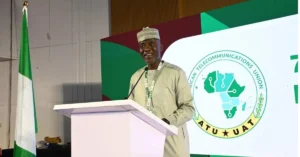
The appeal was made by the Executive Vice Chairman and Chief Executive Officer of the NCC, Dr. Aminu Maida, during the opening of the 7th Ordinary Session of the African Telecommunications Union (ATU) Conference Preparatory Committee, held in Abuja on Tuesday.
Maida said the meeting was convened to develop Africa’s unified position ahead of the International Telecommunication Union (ITU) Plenipotentiary Conference (PP-26), scheduled to take place later this year in Doha, Qatar.
Welcoming delegates from across Africa, he described the gathering as a strategic platform for building consensus on critical issues that will shape the future of telecommunications and the digital economy.
According to him, Africa’s ability to influence global policy discussions depends largely on the quality of its preparations, the unity of its positions and the consistency with which member states pursue shared priorities.
He noted that the Conference Preparatory Committee plays a vital role in enhancing Africa’s participation in international telecommunications policy by helping member countries harmonise their perspectives and develop technically sound common positions ahead of major global meetings.

Maida explained that the committee would review the activities of the ATU between 2023 and 2026 and prepare recommendations, decisions and resolutions for consideration at the ATU Conference of Plenipotentiaries (CPL-26).




He added that participants would also assess Africa’s readiness for the ITU PP-26, where key decisions on the future of the global telecommunications industry are expected to be taken.
The NCC boss stressed the importance of sustained and institutionalised regulatory cooperation across African countries, noting that issues such as spectrum harmonisation, artificial intelligence, cybersecurity, digital trust, data protection and universal access require continuous collaboration beyond periodic conferences.
He also highlighted the need to strengthen Africa’s technical participation in international telecommunications processes, including study groups, technical committees and regional preparatory meetings where global standards and frameworks are developed.
According to Maida, Africa’s influence in global decision-making must be driven by strong technical expertise, credible evidence and consistent engagement.
He further emphasised that the continent’s perspectives should be adequately represented in global digital transformation discussions, citing Africa’s expanding digital economy, growing connectivity and youthful population as key factors that make its contributions increasingly important to the future of the global ICT ecosystem.