

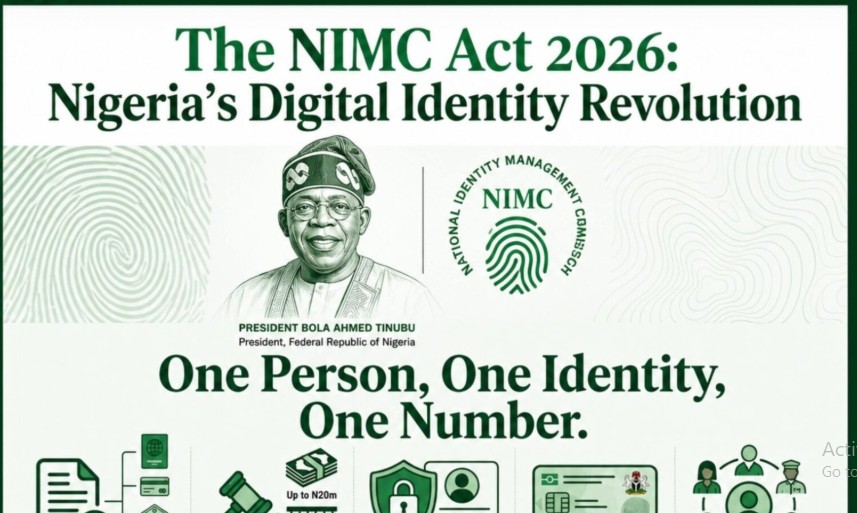
The President, Bola Ahmed Tinubu on Friday signed the National Identity Management Commission (NIMC), Act 2026 into law.
The new Act will now replace Nigeria’s 20-year-old analogue identity management system with a modern digital identity structure.
The new legislation positions NIMC as the central authority for Nigeria’s Digital Public Infrastructure (DPI), and National Public Key Infrastructure (NPKI), replaces a legacy framework written for a different era.
By making the NIN mandatory for banking, land, telecoms and voting, the government is tying Nigeria’s formal economy to a verified digital identity. The higher penalties and privacy safeguards are aimed at building public trust as more services move online.
According to the presidency, the overhaul is intended to create a trusted digital foundation to verify identities, secure electronic signatures, protect transactions, and support Nigeria’s push toward a $1 trillion economy.
Under the new model, identity management is built around security, inclusion, and interoperability across public and private systems. The expanded NIN will reduce duplication, curb fraud, and create a single trusted credential for both physical and digital interactions.
While signing the new Act, President Tinubu averred that “We will not tolerate those who forge identities, steal the identities of others, or exploit the system.”

According to him, the law specifically strengthens corporate governance at NIMC, expands board representation, and imposes stricter accountability on the Commission.

A central provision of the Act is the “One Person, One Identity, One Number” principle. The National Identification Number, NIN, will now be compulsory for accessing a wide range of services, including:
Furthermore, the Act places a strong emphasis on data privacy as personal information can no longer be accessed or used beyond its stated purpose without explicit legal authorization and the individual’s consent.
To deter abuse, the law introduces a 100-fold increase in penalties for identity-related crimes. Convictions for identity theft, forgery, multiple registrations, or unauthorized data access now carry a minimum of five years imprisonment and fines of up to ₦20 million.
The legislation also mandates expanded enrollment to cover underserved populations, marginalized communities, and Nigerians in the Diaspora, to ensure no citizen is excluded from economic opportunities due to lack of identity.
The government will introduce a General Multipurpose Card. The single credential will combine multiple verification functions into one physical and digital asset for use across sectors.
The Act takes effect immediately, with NIMC expected to publish implementation timelines and guidelines for enrollment, data compliance, and rollout of the new card in the coming weeks.