
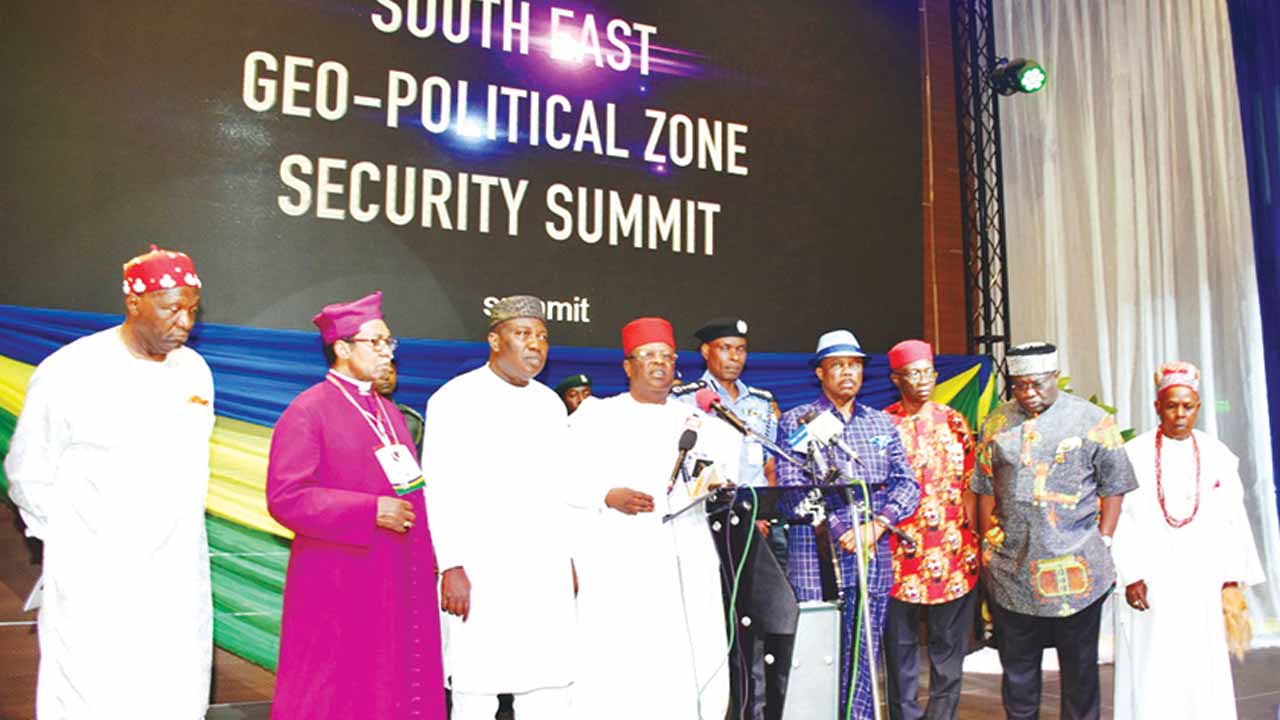
President-General, Ohanaeze Ndigbo, John Nwodo (left); Bishop of Enugu Diocese, Anglican Communion, Emmanuel Chukwuma; Enugu and Ebonyi governors, Ifeanyi Ugwuanyi and David Umahi; Inspector-General of Police, Mohammed Adamu; Anambra State Governor Willie Obiano; Deputy Governor of Imo State, Prof. Francis Njoku; Governor Okieze Ikpeazu of Abia State and representative of South-East traditional rulers, Igwe Lawrence Agubuzu, during the South-East geo-political zone security summit in Enugu…
In view of facts and figures gotten from credible sources and mainly the Nigerian Independent System Operator (NISO) and published by data platform StatiSense, it has become clear that the South East of Nigeria has been officially underfed with electricity from the national grid even through the bulk of gas powering the turbines come from there.
Latest checks showed that whereas Nigeria’s national grid handed Abuja 503 megawatts of electricity on 24th March 2026, on the same day, it gave the entire South-East just 203 megawatts. That is less than half, for five times the territory.
Business Hilights recalls that the five states of southeast have over 26 million people, thousands of businesses, hundreds of hospitals, and one of the country’s oldest and most commercially active regions, but still yet, it receives less than 30 per cent of what a mere capital territory gets.
Otherwise, the South-East is, by every measurable grid metric, one of the most under-served regions in Nigeria, and the gap between what the zone receives and what the national capital receives is not narrowing.

To understand what 203 megawatts actually means for the South-East, StatiSense’s analysis of the national grid data for 24 March calculated that if Nigeria’s total distributed load of 2,793 megawatts were shared equally across the country’s estimated 49.5 million households, each home would receive just 56 watts, which is barely enough for a single energy-saving bulb.

Additional details further reveals that for the South-East specifically, the figure is far worse. Enugu Electricity Distribution Company (EEDC) serves approximately 1.37 million registered customers across five states. If 203 megawatts are spread across the customer base, each connection receives roughly 148 watts. Not enough for a fan and a laptop running simultaneously, and not enough for a refrigerator.
In terms of the consequences of the power short supply policy against the Igbo state, in Onitsha, Aba, Owerri, Enugu city, Abakiliki, and Umuahia, diesel and fuel generators have become as fundamental to doing business as having a shop front.
Across the five states, an entire parallel energy economy, powered by fuel imports, inverter batteries, and increasingly by solar panels, has emerged not out of innovation but out of desperation, as businesses and households gave up waiting for a grid that consistently delivers a fraction of what they need.