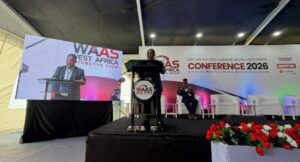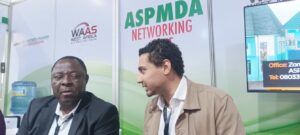


DG of NADDC, Otunba Joeseph Osanipin, ASPMDA President, Luqman Mahmud and others at the officials flag off and cutting of tape at WAAS 2026
…Over 200 foreign exhibitors showcase auto spare parts
It was another eventful year of growth and expansion in the Nigerian motoring industry as the 2026 West African Automotive Show (WAAS) was flagged off by the Director General of National Automotive Design and Development Council (NADDC), Otunba Oluwemimo Joseph Osanipin at the Landmark Centre, Victoria Island, Lagos on Tuesday.
In his keynote address at the opening ceremony, Otunba Osanipin said “his agency has in the last couple of year been in the forefront of championing the training and retraining of auto technicians across the federation”.
He explained that the essence of the massive training outreach amongst other things is to raise more auto technicians that will be able to deliver auto maintenance of vehicles so as to keep the nation moving with ease.

Business Hilights.ng recalls that NADDC is a Nigerian government agency under the Federal Ministry of Industry, Trade and Investment that drives the growth of the local automotive sector. Its primary function is to implement policies like the NAIDP and NAIDP to promote, design, and manufacture vehicles. It oversees local content development, sets industry standards, and encourages investment in vehicle manufacturing and component production.
Key Functions of the NADDC:
Policy Formulation and Implementation: Develops, supervises, and reviews policies, specifically the Nigeria Automotive Industry Development Plan (NAIDP) to transition from vehicle assembly to local manufacturing, targeting 40% local content by 2032.


Local Content Development: Creates “deletion policies” that specify which automotive parts must be produced locally rather than imported, boosting local industrial capacity.

Industry Regulation and Standards: Sets and enforces standards for automotive parts and vehicles to ensure quality and safety, including certifying CNG conversion kits and workshops and supervising end-of-life vehicle recycling.
Infrastructure Development: Facilitates and establishes infrastructure to support the auto sector, including testing centers and training facilities, such as the Automotive Training Center in Ekiti State.
Investment Promotion: Encourages investment in the production of raw materials like steel and alloys, as well as the assembly of vehicles.

Electric Vehicle (EV) Promotion: Drives the adoption of advanced technology and eco-friendly vehicles, aiming for 30% locally produced vehicles to be electric by 2032.
Research and Forecasting: Forecasts demand and supply for vehicles, raw materials, and equipment to guide industry growth.
The NADDC, established by Act No. 6 of 2014, ensures that vehicles produced in Nigeria meet international standards.