
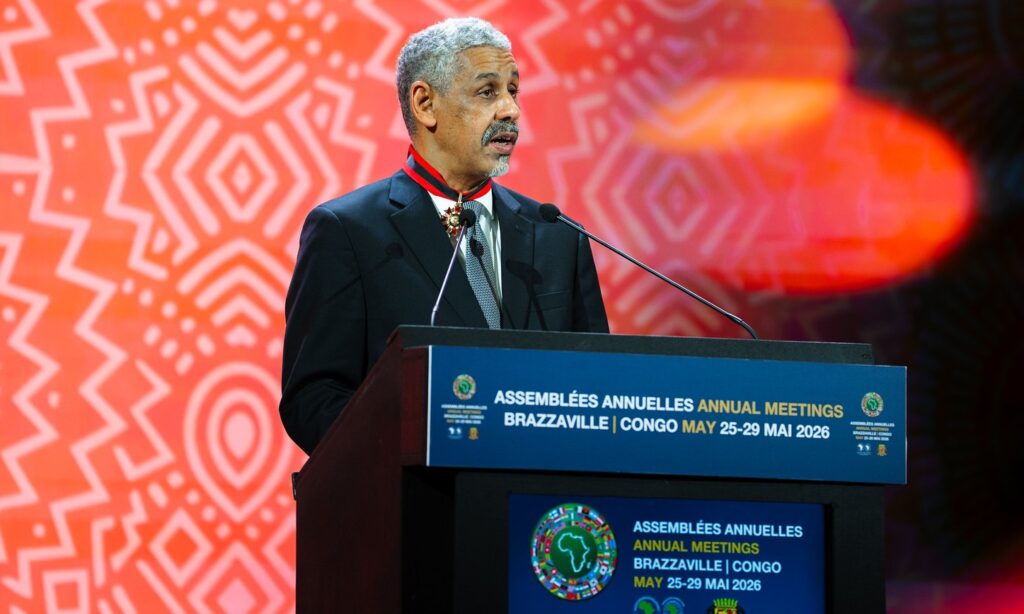
President of African Development Bank (AfDB), Dr. Sidi Ould Tah
The new President of African Development Bank (AfDB), Dr. Sidi Ould Tah has made it clear that the continental financial giant has stood by Africa as continent in every situation both god and bad in the last 10 decades of existence.
Delivering his keynote address at the opening of the 2026 Annual Meetings of the AfDB in the Congolese capital, Brazzaville, Dr Ould Tah, averred that “For more than sixty years, this Bank has stood by the continent through its moments of hope, its periods of turbulence, its profound transformations and its waves of renewal. It has helped to build roads and electricity grids, supported farmers and entrepreneurs, built capacity and connected economies.”
While noting that the band had stood by and supported Africa for more than 60 years, he cautioned against external financial policy influence in the continent, saying “Africa’s development must increasingly be shaped by African ambition, African institutions and African leadership”.
According to him, “After speaking to and listening to different groups, experts, including leaders, innovators both young and old, and reflecting on their different perspectives and priorities; One message kept coming up: Africa’s ambitions have now outstripped the financial architecture available to support them.”
He was quick to argue that it is not because Africa lacks ideas or vision, and neither is it because it lacks resilience, saying “But because the gravity of the moment now demands institutions capable of moving faster, mobilising more capital, building stronger partnerships and rethinking development finance.
“Africa accounts for around 18 per cent of the world’s population. It holds over 30 percent of the world’s mineral resources and over 60 percent of the world’s unexploited arable land. And yet, Africa accounts for only around three percent of global trade and between three and four per cent of global GDP,” he said.
“The continent faces an estimated annual financing requirement of over $400 billion to ensure its structural transformation. Yet Africa also has over $4 trillion in domestic savings and assets — held in banks, pension funds, insurance companies, sovereign wealth funds and other financial institutions.

In his key submission, Dr. Ould Tah hinted that Africa needs between $130 billion and $170 billion annually to meet its infrastructure needs, with an estimated funding gap of between $68 billion and $108 billion per year.


He listed what Africa can offer seamlessly to the world to include but not limited to investment opportunities in energy, logistics, digital infrastructure, food systems and critical minerals.
Dr Ould Tah posited that the debate on whether Africa has potential is over and stressed that “the real question now is whether Africans themselves are capable of transforming the continent’s assets into productive investment, jobs, value creation and economic influence”.
Commenting on the prevailing international energy crisis, he opined that “External inflationary pressures have affected households and public finances across our continent. Critical supply chains have been weakened. Official development assistance has fallen sharply. And rising interest rates have significantly increased the cost of capital for African economies. Geopolitical fragmentation has returned to the forefront of international relations. And amidst these upheavals, one thing has become clearer. Africa is no longer on the periphery of major global systems.”
“From the Suez Canal to the Cape of Good Hope… From the Bab el-Mandeb Strait to the critical mineral corridors fuelling the energy transition… the continent has become central to the way the world thinks about logistics, energy security, critical minerals and future growth.
“The world is gradually rediscovering what Africa has always known: geography still matters. And yet, the most significant change may not be external. It is internal,’ he said.
Business Hilights.ng reports that the ongoing 2026 AfDB Annual Meeting themed: ‘Mobilising Africa’s Development Financing at Scale in a Fragmented World’ is expected to close tomorrow, May 29, 2026.