
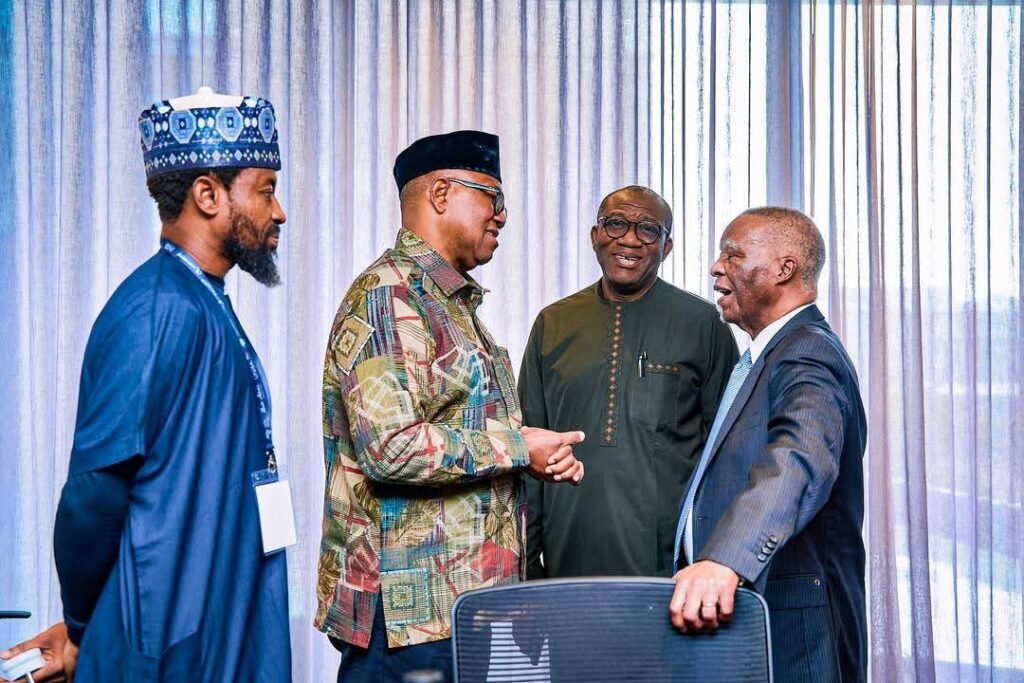
Peter Obi in South Africa discussing with former President, Thebo Mbeki and others to end xenophobic attacks against blacks by blacks South Africans
Recently, Nigeria’s frontline presidential hopeful and former Governor of Anambra State, Mr. Peter Obi travelled to South Africa at the heat of xenophobic attacks on black foreigners by black South African.
In his usual diplomatic intelligence, he held strategic meetings with leaders including former President Thebo Mbeki, President Ian Khama of Botswana and even the Nigerian community in the country.
Obi wrote on his Facebook wall saying thus: “My final engagement before leaving Capetown for Johannesburg yesterday, I had the privilege of meeting two distinguished former leaders, President Ian Khama of Botswana and President Thabo Mbeki of South Africa, before departing Cape Town for Johannesburg yesterday.
“This meeting was an opportunity for me to express my heartfelt appreciation for their positive comments on the recent immigration issues in the region and their continued advocacy for peace and unity among African nations.
“Both Mr Khama and Mr Mbeki continue to hold significant respect across the continent due to their remarkable contributions, both during and after their presidencies.
During my audience with Mr. Mbeki, I also reconnected with my good friend, former Ekiti State Governor Dr Kayode Fayemi, who delivered a keynote address at the Thabo Mbeki Africa Day lecture, focusing on the themes of rebuilding unity and revitalising institutions throughout the continent.
“This event was organised by the Thabo Mbeki Foundation.
One of his ardent followers wrote about the trip in a post saying “This Southern Africa trip with Mr. Peter Obi, from Lagos to Johannesburg to Cape Town and back has been, for me, far beyond movement across cities and meetings across borders. It has been an opportunity for deep observation, learning, reflection, and a closer understanding of leadership, nation-building, and the burden of carrying the hopes of people across different spaces and circumstances.
Beginning in Cape Town, at the Spier dialogue on Africa’s growth and development, I watched Mr Peter Obi engage leaders from across the continent and beyond with remarkable humility and depth. Mr Peter Obi introduced me to the Mayor of Cape Town, political leaders, diplomats, academics, development experts, and participants who had come from different parts of Africa, Europe, and America. What stood out immediately was not merely recognition, but the genuine warmth, respect, and attentiveness with which people received him. Across ideological and political divides, there was a visible acknowledgment of his consistency, clarity, and moral standing.
“For me, however, the most profound moments were often not on the podium, but in the quieter spaces, observing how Mr Peter Obi listens, the questions he asks, and the seriousness with which he approaches even the smallest conversations. Whether speaking to former Presidents, current ministers, political leaders, diaspora Nigerians, or ordinary citizens, his first instinct is always to ask questions, How are Nigerians faring? What are the challenges? How are our people treated? What opportunities exist? What lessons can Nigeria learn? What systems are working? What systems are failing?

There is something deeply instructive about seeing a leader genuinely curious, genuinely listening, and genuinely concerned. At the dialogue in Cape Town, when Mr Peter Obi delivered his key address on policies for growth in Africa, he spoke with clarity about the tragedy and paradox of a continent so blessed with natural and human resources still struggling under the weight of poor leadership, corruption, weak institutions, and misplaced priorities. But what struck me most was how seamlessly he connected the broader African conversation with the realities at home in Nigeria.


“Mr Peter Obi spoke about leadership not as an abstract concept, but as a lived responsibility. He explained how the quality of governance within a nation ultimately reflects how its citizens are perceived and treated beyond its borders. That leadership at home shapes dignity abroad. That when governance fails, citizens often carry the burden internationally. Yet even while addressing difficult truths, he consistently defended the integrity, resilience, brilliance, and hard work of Nigerians everywhere. Mr Peter Obi raised hope while still confronting reality. He challenged systems without condemning people. He spoke honestly, but never hopelessly.
“In Johannesburg and Cape Town, the interactions with Nigerian communities were deeply emotional and revealing. Many shared concerns, fears, frustrations, and experiences about migration, identity, economic hardship, and social tensions. Yet in those interactions, I also saw something else, the trust and emotional connection people have with Mr Peter Obi. Not merely politically, but personally. People spoke to him as someone who understands their pain and still believes in their future.
“Watching Mr Peter Obi’s engagements with South African ministers and political leaders was equally enlightening. The discussions were thoughtful, respectful, and frank. There was no grandstanding, no unnecessary drama, just serious conversations around governance, migration, law, regional cooperation, and the future of Africa. Even in disagreement, there was mutual respect.
“One particularly humbling moment for me was being present during his conversation with former President and elder statesman, Thabo Mbeki with Governor Kayode Fayemi . Listening to them reflect deeply on Africa, governance, peace, law, and continental progress was an experience difficult to fully capture in words. There was wisdom, historical perspective, and a shared belief that Africa must rise above division, poor governance, and narrow politics if it truly hopes to fulfill its promise.
“What became increasingly clear throughout this trip was the extent of the respect Mr. Peter Obi commands both at home and abroad. It cuts across political affiliations, generations, professions, and even nationalities. There is a reverence many hold for him not because of power or office, but because of consistency, discipline, civility, and the perception and knowledge that he genuinely places people above self-interest.
“What also struck me deeply is how even leaders who may differ politically or operate within parochial environments still often speak of him with unusual regard, almost as though they see in him a reflection of the kind of leadership Africa desperately needs, measured, competent, humane, accountable, and focused on development.
For me personally, this trip has reinforced that leadership is not noise. It is not aggression. It is not performance. Leadership is preparation, empathy, discipline, curiosity, courage, consistency, and the ability to carry people’s hopes without losing touch with their realities.
“This journey has therefore become, for me, an ongoing classroom, one of observation, learning, growth, reflection, and deeper conviction about what Nigeria can and should become. It has shown me that despite the criticisms, the resistance, the misunderstandings, and the countless challenges, one must not give up on the nation or the continent.
“We must continue to engage, learn, build, hold on to hope and above all, we must continue pressing on toward the vision of a more just, competent, peaceful, and prosperous Nigeria and Africa.